
Renovation budgets feel like guesswork to most homeowners, but that's not how the professionals see it. Skilled estimators use structured, data-backed systems to price every nail, hour of labor, and permit fee before a single wall comes down. The gap between a project that stays on budget and one that spirals out of control almost always comes down to how the estimate was built in the first place. This guide breaks down exactly how renovation costs are calculated, what drives them up or down, what American homeowners are paying in 2026, and how you can build a budget that actually holds.
Table of Contents
- How renovation costs are calculated: The industry standard
- The variables that define your renovation cost
- National cost benchmarks: What does renovation really cost in 2026?
- Budgeting and planning: Steps to define and control renovation costs
- Why most homeowners underestimate renovation costs and how to outsmart the common pitfalls
- Take the guesswork out of your next renovation project
- Frequently asked questions
Key Takeaways
| Point | Details |
|---|---|
| Transparent estimation methods | Professional estimators use data-driven unit pricing like RSMeans for precise and transparent cost breakdowns. |
| Multiple factors impact price | Location, project scope, material quality, and labor rates all play major roles in your final renovation cost. |
| Always include contingency | Adding a 10-20% contingency is essential since the majority of projects exceed planned budgets. |
| Benchmarks guide planning | Comparing your project to up-to-date national benchmarks helps prevent unrealistic expectations. |
| Plan each step | A structured, step-by-step budgeting and review process is your best defense against surprise costs. |
How renovation costs are calculated: The industry standard
Most homeowners receive a single number from a contractor and have no idea how it was derived. Professionals, however, build estimates from the ground up using unit cost methodologies. Home renovation costs are estimated using unit cost databases like RSMeans, organized by CSI MasterFormat divisions, which group work into logical categories like concrete, masonry, finishes, and mechanical systems.
The RSMeans unit cost guide contains over 92,000 line items, each with embedded material costs, labor hours, equipment needs, and productivity rates. That last part matters more than most people realize. Productivity rates tell the estimator how long a task actually takes in the real world, not an idealized scenario. A tile setter might install 50 square feet per hour under normal conditions, but that rate drops in tight spaces or with complex patterns.
Here's a simplified view of how a professional estimate is structured:
| Cost component | What it covers | Typical share of total |
|---|---|---|
| Materials | Lumber, tile, fixtures, finishes | 40-50% |
| Labor | Installation, skilled trades | 30-40% |
| Equipment | Rentals, tools, machinery | 5-10% |
| Overhead & Profit | Business costs, margin | 15-25% |
Local market adjustments are applied for 970+ cities and regions, so a bathroom remodel in Houston is priced differently than the same job in Boston. These city cost indexes reflect local wages, material delivery costs, and market demand.
Key steps in a professional estimate include:
- Define the scope clearly before any numbers are assigned
- Assign unit costs from a current database for every line item
- Apply local adjustments using regional cost indexes
- Add overhead and profit as a percentage of the subtotal
- Build in contingency for unknowns
This is what line item cost estimation looks like in practice. It's not a gut feeling. It's a structured process that leaves a paper trail you can audit.
"A single lump-sum quote tells you nothing. A line-item estimate tells you everything."
Pro Tip: Always ask your contractor for a line-item breakdown, not just a project total. If they can't provide one, that's a red flag.
The variables that define your renovation cost
Even with a solid estimation method, two identical projects in different cities can cost vastly different amounts. Understanding the breakdown of renovation cost drivers helps you set realistic expectations before you even call a contractor.
Key factors defining costs include location, project scope, material quality, labor rates, home age, and permits. Here's how each one plays out:
Location is the biggest wildcard. Urban markets like New York or San Francisco run 20-40% above the national average, and some regions swing total costs by as much as 50-70%. A kitchen remodel that costs $35,000 in Dallas might run $55,000 in Los Angeles for the same finishes and footprint.
Project scope determines complexity. Cosmetic updates like paint and flooring are the cheapest category. Structural changes, such as removing load-bearing walls, add engineering fees and inspections. Systems upgrades, including electrical panels, plumbing reroutes, or HVAC replacements, are the most expensive because they require licensed trades and permits.
| Scope type | Examples | Cost impact |
|---|---|---|
| Cosmetic | Paint, flooring, fixtures | Lowest |
| Structural | Wall removal, additions | Medium-High |
| Systems | Electrical, plumbing, HVAC | Highest |
Material quality accounts for 40-50% of your total budget. Choosing stock cabinets versus custom ones can double that line item alone. The same logic applies to countertops, tile, and windows.
Labor rates average $50-100 per hour nationally, but skilled trades like electricians and plumbers often push above that range, especially in tight labor markets.
Permits and regulatory fees typically run $500-$3,000 for major work and are non-negotiable for structural or systems projects. Skipping them creates legal and resale problems.
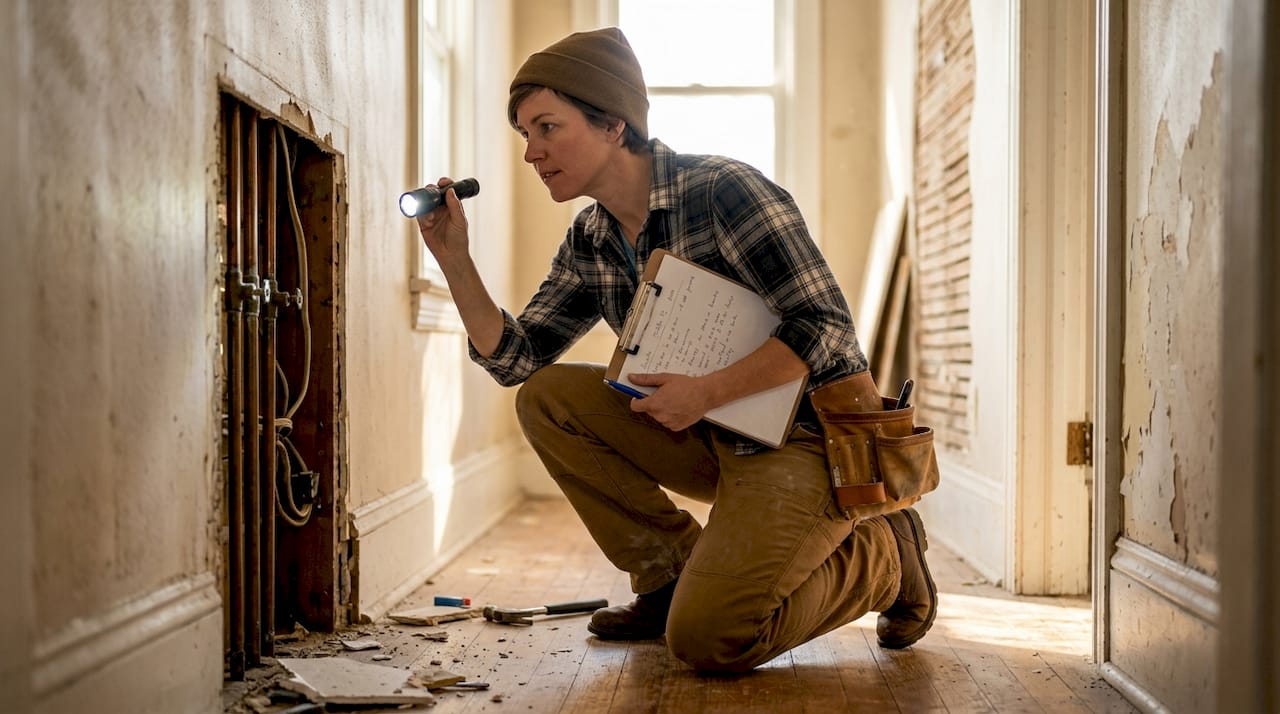
Older homes carry hidden risks. Knob-and-tube wiring, asbestos, lead paint, and outdated plumbing are common surprises that require higher contingency budgets.
Overhead and profit (O&P) adds another 15-25% to your subtotal. This is legitimate. It covers a contractor's insurance, vehicles, office costs, and reasonable business margin.
Pro Tip: Ask for a cost breakdown organized by category so you can see exactly where your money is going. Materials, labor, and fees should each be listed separately.
National cost benchmarks: What does renovation really cost in 2026?
Knowing what drives costs, let's look at what American homeowners are actually paying in 2026. These renovation cost benchmarks give you a reality check before you commit to a scope.
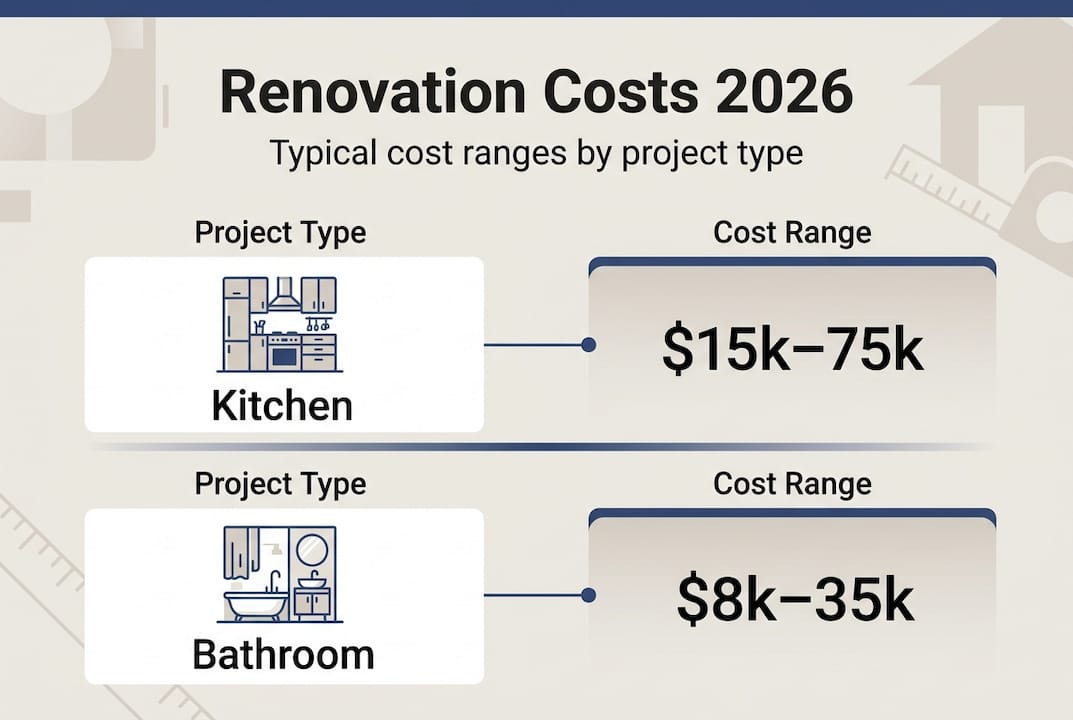
National benchmarks for 2026 show kitchen remodels ranging from $15,000 to $75,000, with mid-range projects landing between $30,000 and $50,000. Bathroom remodels run $6,000 to $40,000, with mid-range at $15,000 to $25,000. Whole-house renovations average $100,000 to $300,000, or roughly $60 to $150 per square foot.
| Project type | Low end | Mid-range | High end |
|---|---|---|---|
| Kitchen remodel | $15,000 | $30,000-$50,000 | $75,000+ |
| Bathroom remodel | $6,000 | $15,000-$25,000 | $40,000+ |
| Whole-house renovation | $60/sq ft | $100/sq ft | $150+/sq ft |
| Contingency buffer | 10% | 15% | 20% |
Use a remodeling cost calculator to cross-reference your specific project against these ranges. If a quote comes in 30% below the low end, ask why. Suspiciously low bids often mean cut corners, unlicensed labor, or missing scope items that will resurface as change orders.
Return on investment is worth factoring in too. Minor kitchen remodels deliver an ROI of 96-112%, meaning you recover nearly all your investment at resale. Garage door replacements top the list at up to 267% ROI. Not every renovation is about ROI, but knowing these numbers helps you prioritize.
A few additional benchmarks to keep in mind:
- 65% of renovation projects exceed their original budget, so contingency is not optional
- 10-20% contingency is the professional standard for most projects
- Older homes should carry a 20% contingency minimum due to hidden condition risks
- Luxury upgrades and historic properties can push contingency needs even higher
These numbers aren't meant to scare you. They're meant to help you plan honestly.
Budgeting and planning: Steps to define and control renovation costs
Now, let's make these numbers actionable with a practical approach for your own project. The budgeting process follows a clear sequence that any homeowner can apply.
The standard approach involves multiplying your square footage by the applicable per-square-foot rate for your scope, then adding a 10-20% contingency and splitting out materials and labor as separate line items. Cross-reference your totals against NAHB and Cost vs. Value benchmarks to confirm you're in the right range.
Here's a step-by-step process:
- Define your scope in writing. List every task, room, and system you want touched. Vague scope is the number-one cause of cost overruns.
- Measure your space accurately. Square footage drives most per-unit calculations.
- Apply per-square-foot benchmarks for your project type and region.
- Split your estimate into materials, labor, permits, and fees as separate categories.
- Add 10-20% contingency on top of your total, not as an afterthought.
- Compare to credible benchmarks from NAHB or Cost vs. Value reports to validate your numbers.
- Structure payments by milestone, not upfront lump sums, to protect yourself financially.
For additional renovation budget advice, cross-referencing multiple sources before finalizing your numbers is always worth the extra hour.
A few practical controls to apply once the project starts:
- Track spending weekly against your line-item budget
- Approve all change orders in writing before work begins
- Shop materials independently for big-ticket items like cabinets and tile
- Hold back final payment until punch-list items are completed
Pro Tip: Budget for permits and inspections from day one. Permit delays are one of the most common reasons projects stall, and the fees are predictable if you plan for them.
Why most homeowners underestimate renovation costs and how to outsmart the common pitfalls
Here's the uncomfortable truth: most renovation budgets fail not because homeowners are careless, but because the entire process is designed to obscure costs until it's too late to back out. Contractors quote low to win the job. Scope creep adds line items after you've already committed. And homeowners, excited about the finished result, skip the hard questions.
66% of projects experience overruns due to scope creep and unforeseen conditions, especially in older homes and luxury upgrades. That's not bad luck. That's a predictable pattern with a predictable solution.
Professional estimators don't guess. They build in contingency, apply regional indexes, and review every spending category independently. The "one big number" budget is a recipe for disaster because it hides the assumptions underneath. When something changes, and something always changes, you have no baseline to work from.
The contrarian view worth holding: a detailed estimate is not a sign of distrust toward your contractor. It's a sign of a well-run project. The best contractors welcome line-item transparency because it protects them too. Disputes happen when expectations are vague. Clarity prevents conflict.
Use expert budget planning tips to review every category independently: materials, labor, permits, and contingency. Historic homes need even more diligence. A 1920s bungalow is not a 2010 build, and your budget shouldn't treat it like one.
Take the guesswork out of your next renovation project
You now have the framework professionals use to price, plan, and control renovation costs. But knowing the method and having the right tools are two different things.

BidWithBob is built for exactly this situation. The platform gives you get an expert renovation estimate backed by real market data, structured milestone payments that protect both you and your contractor, and a single organized workflow that replaces the chaos of calls, emails, and guesswork. Whether you're planning a kitchen remodel or a whole-house renovation, BidWithBob brings the transparency and structure that most homeowners never get. The safer way to renovate starts with a budget you can actually trust.
Frequently asked questions
What is the most accurate renovation cost estimator for homeowners?
Industry-standard tools like RSMeans provide the most accurate renovation cost data, breaking projects into detailed line items and adjusting for local markets. Cost estimators like RSMeans use over 92,000 unit cost items to build precise, auditable estimates.
How much should I budget for unexpected costs during home renovation?
Experts recommend adding a 10-20% contingency to your project budget because 65% of projects experience unexpected overruns. Older homes and complex scopes should lean toward the higher end of that range.
Why do renovation costs vary so much by region?
Location affects material delivery costs, labor rates, permits, and local demand. Location can swing costs by 50-70%, with urban areas running 20-40% above national averages and markets like California or New York sitting 35% higher than the national baseline.
What is the best way to avoid going over budget?
Get detailed, line-item estimates, benchmark against national averages, and build contingency in from the start. Detailed line-item estimates and benchmarks are the most reliable safeguards against budget overruns.